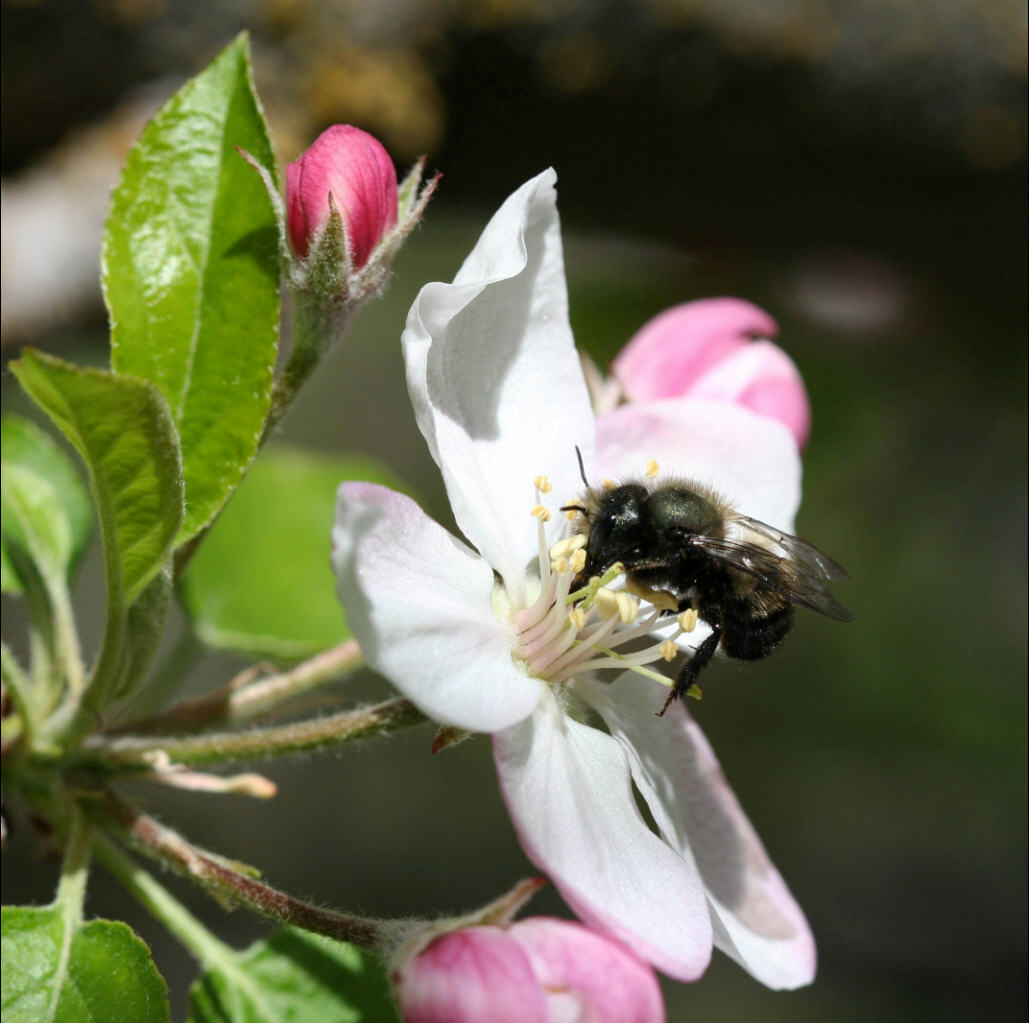
This coming Sunday, June 24, from 2-5 p.m., join Peaceworks’ Center for Sustainable Living for the 2018 Edible Columbia Garden Tour. This year, the tour is exploring several new and very interesting topics, like butterfly and pollinator gardens, fruit trees, irrigation techniques, raised beds and unique uses of yard space for food production! And you’ll get to visit two Community Garden Coalition member gardens: Ash Street Community Garden and Ann Street Community Garden.
Boone County Buzz: We Love Squash (So Do Bugs)
When I hear stories of gardeners abandoning cucurbits (AKA zucchini and other squash) on people’s doorsteps, I wish this was my problem. Why do I have trouble growing these plants? I don’t use pesticides. If you want to kill some bees and reduce your yield, treat your zucchini plants with an insecticide.
My first job at MU was on an EPA program called “Rebuttable Presumption Against Registration.” Our job was to send the EPA data on the pros and cons of using various pesticides. Essentially asking whether the risk was worth the benefit. Based on that experience, when it comes to flea and tick control I’m on-board with man-made chemicals. (I apologize to my Kitty Boys but there is nothing worse than a home flea infestation). However, putting chemicals on something I’m eventually going to eat just doesn’t happen unless it’s absolutely, positively necessary. That means that to harvest a lot of squash and other cucurbits I have to do some serious plant monitoring. My methods are working pretty well, as we have gone from losing our plants to insect pests by the first of July, to harvests still going on in September (knock on wood)! My freezer is filled every year with my version of a delicious summer squash bisque! (If you want the recipe email me!)

Figure 1. Squash bug approximately ½ to ¾ inch long. Photo, Keith Weller, USDA.
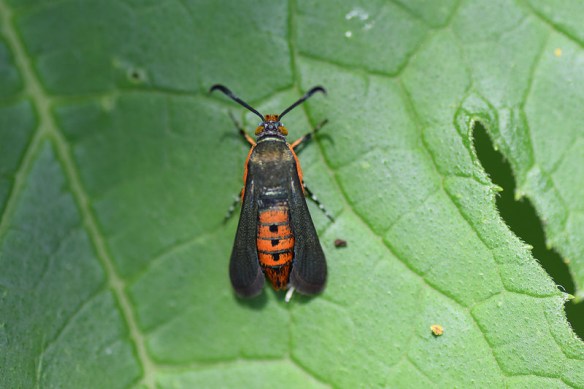
When it comes to growing squash or cucumbers around here, the big problems are squash bugs, squash borers and cucumber beetles. Anyone who has ever grown squash two years in a row knows what a squash bug looks like (Figure 1). The squash borer adult is more elusive (Figure 2). Our cucumber beetles tend to be the twelve-spotted variety (Figure 4).
Here’s what is working for me with the squash bugs and borers.
First, I clean up my garden waste after the first hard freeze in the fall. This way I’m removing overwintering sites for many pests including the squash bugs. Then in the spring, I plant two separate patches with summer squash as far apart as possible and leave 4 or 5 plants per mound. Depending on your garden size I recommend planting your cucumbers and winter squash in the same fashion. It may be crowded at first but it is inevitable in gardens over a year old that one of these pests will kill some of your plants.
Most mornings I get up early (it’s really nice out then — it’s cool, the birds are singing), I put on my flexible garden gloves, take my 5-gallon bucket of soapy water and an aerial (butterfly) net to the garden. First I sneak up on my plants looking for adult squash borers laying eggs near the base of my plants. It’s their larvae in the plant stems that make your otherwise healthy zucchini plant suddenly collapse and die. If you see one you have to act FAST. I swoop the net on top of it and then hold up the end of the net so they will fly up into it. Catching them on the wing is more difficult, but when you succeed it’s thrilling (well at least for a 62 year-old woman).

Figure 3. Squash bug eggs and immature squash bugs. Photo, Zsofia Szendrei, Michigan State University
Then, when I’m done scouting for those I start looking for adult and immature squash bugs, but more importantly squash bug eggs (Figure 3). These are usually laid in clusters anywhere on the plant. When I see the eggs or immature bugs on a plant leaf or stem I remove part or all of that leaf and plunge it under the water in my bucket. If I see an adult or near-adult bug I crush it with my gloved hand or step on it. I’ve killed thousands and never been hurt, so don’t be afraid to do it.
Unfortunately I don’t have much luck removing cucumber beetles by hand. The damage they do to my cucumbers by feeding is negligible, but they do a lot of damage by transmitting a bacterial wilt, which is why I plant several vines on each patch. Usually one of them makes it! For other ideas on how to deal with these pests, take a look at the websites below.
Missouri Botanical Garden – Cucumber beetles
Warm Season Plants & Seeds This Weekend
It’s time to plant all those delicious heat-loving veggies like tomatoes, peppers sweet potatoes and eggplant! For community gardeners, the CGC will host a plant and seed distribution this weekend, so make some time to come by and get what you need to fill out your garden and fill up your plates this summer.
Saturday, May 19
10 a.m. to 2 p.m.
Sunday, May 20
12 p.m. to 2 p.m.
Claudell Lane Garden
711 Claudell Lane
Plants are free to member gardeners, but we welcome donations of $1-$2 per 4-pack to help offset the cost. Row cover will be available for sale. Plus, we still have lots of seeds to offer you for various vegetables and flowers!
ESPAÑOL
Jardineros/as: Tendremos una distribución de plantas para la temporada cálida el sábado 19 de mayo de 10-2 y el domingo 20 de mayo de 12-2. Las plantas estarán disponibles por una donación de 50 centavos cada una en el Jardín de Claudell. Tendremos tomates, pimientos, berenjenas y camote. Si necesita semillas, estas estarán disponibles los mismos días a la misma hora, o puede contactar a Mira a su email: mirabai911@hotmail.com.
This Weekend: Plants & Seeds for Spring
The Boone County Buzz: Bugs in Your Broccoli?
“Cruciferous” vegetables include cabbage, broccoli, kale, cauliflower, arugula, and the list goes on. These crops love cooler weather and are known as “super” foods, because they are packed with nutrition. I don’t grow large quantities of them. It’s not that we don’t like them, but from past experience it seems like all the “heading” types become ready to harvest almost simultaneously. If you don’t have a big family or like to do serious fermenting, pickling and/or canning, it may cause more stress than pleasure. So, if you do like broccoli, cabbage or cauliflower, but have never grown them, I have a suggestion. On March 24th and 25th, the CGC will be offering transplants of these cool season vegetables at the Claudell garden. Why not ask for a couple of each? That way you can see how it goes without being forced to get 4-6 of them at the nursery or big box store. Also, please remember when picking up these plants that a donation helps us keep all of this going!
Another reason for the scarcity of these types of veggies in my garden is the large number of insect pests that LOVE cruciferous plants. I don’t like to use chemicals, especially on the parts of a plant I’m going to eat. This means that for each cruciferous vegetable that I do grow I spend a lot of time monitoring it for pests.
When I walk out for my daily garden inspection I’m always wearing lightweight, flexible gardening gloves and carrying a bucket of soapy water. This allows me to crush or drown every garden pest I encounter. (Though bunnies and turtles get a pass.) For someone who has pet spiders in her home, I can be surprisingly vicious when it comes to biological control on my plants. Another possibility is row covers which will at least slow down the flying pests. Our long-time board member Bill McKelvey says that he grew spectacular cauliflower and broccoli last year using row cover, so I’m going to give it a try. The materials for row covers will be available along with seeds and the transplants at the Claudell Garden on the aforementioned dates.
Unfortunately, I can think of twelve different species that can wreak havoc on various cruciferous vegetables. I don’t have the time, space or inclination to address all of these potential pests and chemical-free ways to grow them, but fortunately I don’t need to. Below you will find several links where someone has already done it for me.
Identification of cruciferous insect pests:
- University of Kentucky Extension – Cabbage pests
- University of Minnesota Extension – Caterpillar pests of cole crops in home gardens
- Clemson University Extension – Cabbage, Broccoli & Other Cole Crops Insect Pests
Earth friendly suggestions for control of some of these pests
(Tip: These sites all offer recommendations on other pests, too.)
Cool Season Transplants & Seeds
If our cool weather keeps hanging around, it could end up being a great spring for plants like cauliflower, broccoli, kale and cabbage!
The CGC will have seedlings of these cool-weather crops available for community gardeners next Saturday and Sunday, March 24 & 25.
Payment is not required, but if you can afford to make a small donation, we suggest about 50¢ per plant which helps us cover the costs for those who cannot pay.
Just come by the Claudell community garden, 711 Claudell Lane during the following times:
- Saturday, March 24, 10 am-2 pm
- Sunday, March 25, Noon-2 pm
Also Available
We have ROW COVER you can use to protect young plants from chewing insects while still letting light and water through. It is used with metal hoops to hold it up over your plants. We suggest a donation of 25¢ per linear foot of cover and for each hoop.
And, we also have vegetable and flower SEEDS for those who missed our Spring Thaw giveaway last month. We still have some of everything that was available at the Thaw (peas, beans, leafy vegetables, carrots, herbs, beets, radishes, squash, etc.) and some new flower seeds donated by Baker Creek.
Please note this event is meant for gardeners at our member gardens.
The Boone County Buzz: Bumble Bees and Why You Should Like Them
I like bumble bees. This despite a traumatic incident as a small child when I was stung by one (I can still see her coming at me!). Anyway, I’ve gotten over that, and I do everything I can to encourage them in my gardens, which are filled with them on sunny days. Why do I like them? Well, for starters, they are beautiful, industrious insects that benefit my plants. They also are an important part of our ecosystem and deserve to be here.
We have ten recognized species of bumble bees in Missouri and all of them are important pollinators. However, only four of these species occur commonly: the Common Eastern, Two-spotted, Brown-belted and Half-black bumble bees. Great names, aren’t they?
Bumble bees are great generalist pollinators, meaning that each species may feed on the nectar of several vegetable, fruit or flower crops while collecting and feeding the pollen to their larvae. They are “eusocial” like honey bees, meaning they have different “castes” that perform different tasks for the benefit of the colony. However, they differ from honey bees in that the colonies are much smaller, occur in the ground and only last one year. Newly inseminated queens overwinter before starting a new colony in the spring.
Every year, someone tells me about how a bumble bee was acting territorial with them or other bumble bees. It was hovering about head height and challenging anything that came near. That’s why I decided to write this article. A bee like that isn’t a bumble bee!
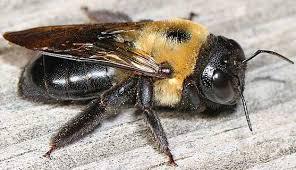
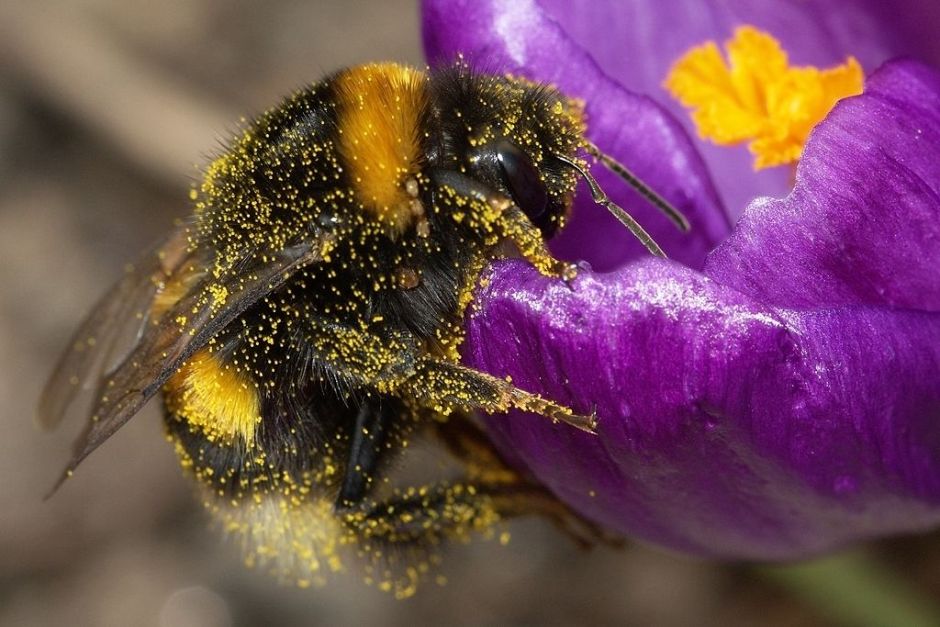
If you look closely at a bee acting territorial, you’ll see that it’s abdomen is shiny and hairless (Figure 1), unlike the abdomens of bumble bees (Figure 2). With proper training you would also see that it is a male bee, and unable to sting you despite his bravado. The bee I’m describing is the Eastern Carpenter bee.
To be honest, I set out to show you the difference because I was trained 40 years ago to dislike this species because it damages wood. However, in doing some background reading I’ve come to realize that feelings towards this bee have changed. The Eastern Carpenter bee does damage wood, including unpainted fresh lumber of the pine and cedar varieties. They do this when the female tunnels into the wood so that she can lay her eggs. This species is also capable of being a nectar robber, meaning that it sometimes rips open the corollas of tubular flowers to get at the nectar while failing to pollinate them. However, despite these negatives, researchers now believe that they still do a lot of beneficial pollinating, albeit not at the level of honey bees or bumble bees. So, now it’s up to you to decide what to do about them. When I see them in my garden, I will let them be, but I’ll still net and dispatch any females trying to damage my potting shed.
More information on bumble bees and bees in general:
- A pictorial guide to the bumble bees in Missouri and Illinois
- Use of Bees with Vegetable Crops
- Bumble Bees of the Eastern United States
(By Sheila Colla, Leif Richardson, and Paul Williams. US Dept Agriculture) - Bee Basics An Introduction to Our Native Bees
(By Beatriz Moisset and Stephen Buchmann. A USDA Forest Service and Pollinator Partnership Publication.)
The Boone County Buzz: Beneficial Insects for Your Garden
Garden leader Calvin Miles, from Friendship Garden Club, recently asked me a very good question, “What are the good insects?”
Well, first off, we want pollinators. As I mentioned in my last post about “insect hotels,” these include honey bees, bumble bees, solitary bees, ants, butterflies, moths and some flies. Where this gets tricky is that some butterflies and moths are actually laying eggs so their young can devour your crops. I could go on (and on, and on), but, generally, if you see a butterfly or moth hanging around your cole crops or corn it is probably laying eggs because these plants don’t require pollinators. Of course, it may also just be taking a rest. One rule of thumb is that if it’s a pretty butterfly, give it a nudge to move it along. If it returns and especially if it’s white or yellow, get rid of it if you can.
So, beyond pollinating many of our crops, insects may be beneficial to our gardens by consuming other insects and relatives that damage our crops. There are dozens of these beneficials, so I’m just going to address the ones I most commonly see in my Columbia garden. Then I’ll list some good websites for readers who want more information.
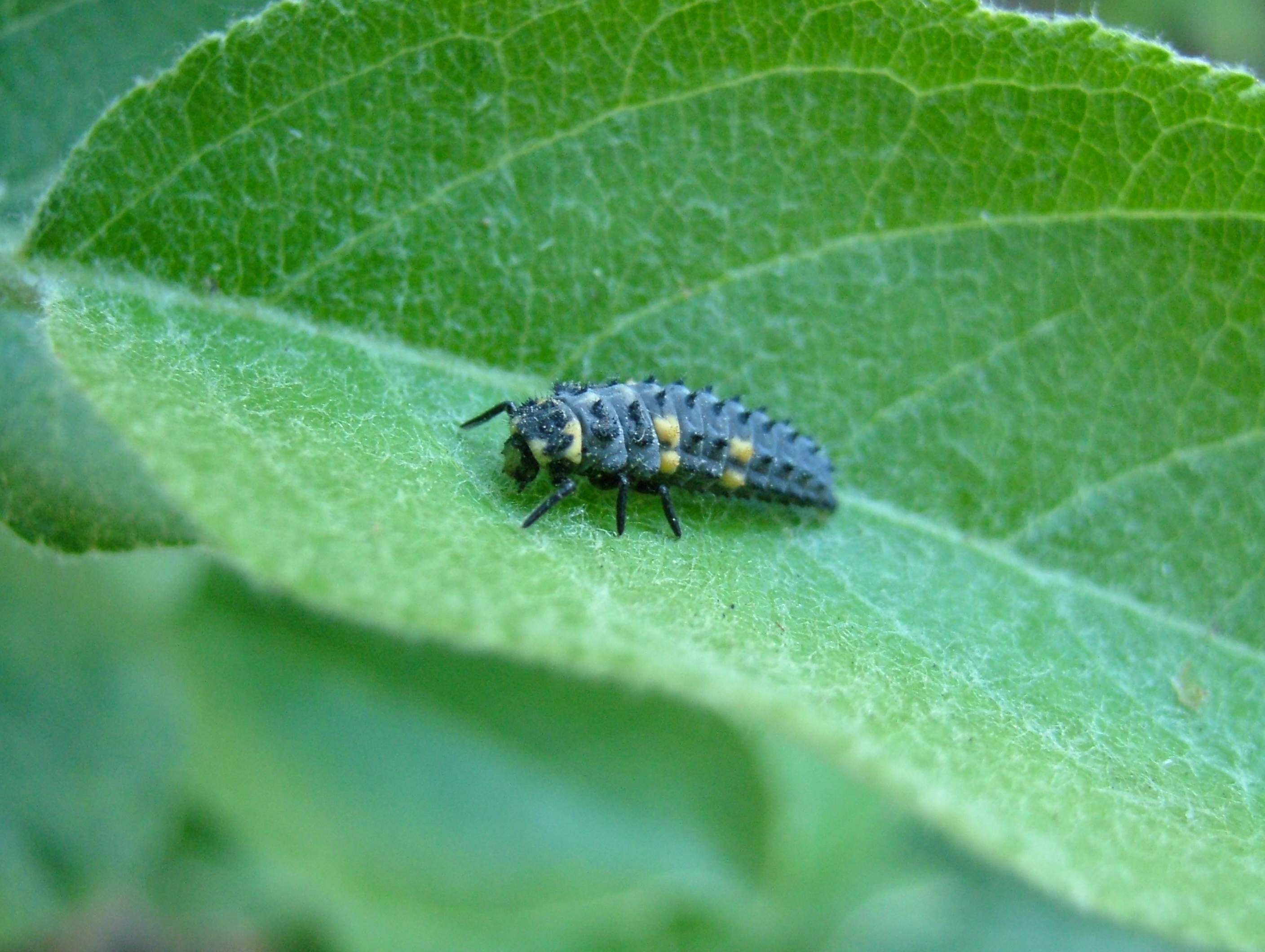
Most everyone knows what a ladybug looks like. Maybe you also know that they help our gardens by eating aphids and other small plant pests. Did you know that immature ladybugs do the same thing? They range from a few millimeters to ½-inch in length. Here is picture of one so you know to leave it alone or move it to a plant with an aphid infestation!
Another good type of insect to find in your garden is a praying mantis. There are three species found in Missouri, ranging in size from about 2½ to 5 inches, and in coloration from brown to bright green. These feed on most anything they can catch, even including, on rare occasions, hummingbirds. I’ve seen a picture of this and actually found a pair of hummingbird wings mixed in with the butterfly wings beneath one of my Chinese mantises! Survival of the fittest, right? EEK! That said, put a mantis on your green bean plants and forget about leaf damage.
Lacewings are another great predator. The adults and young both eat aphids, small caterpillars, mites, etc. (and fortunately not hummingbirds). The adults are about ¾-inch long and may be green or brown. Larvae are about a ½-inch long and brown.
Stink bugs…are way too complicated. Generally speaking, stink bugs feed on our crops and damage them by sucking fluids. However, a few species of stink bugs suck the juices out of all
kinds of crop-destroying caterpillars. Unfortunately, even I can’t tell the good guys apart from the pest species without a magnifying glass. While all stink bugs have long, tube-like mouthparts, the predators have a broader tube than the plant feeding types. So, unless you find a stink bug in the process of killing something else, you might just go with the odds and kill any that you see. (If you’re game to try sparing the predatory species, though, read to the end for a couple good guides to common species.)
Another group of beneficial predatory insects I often see is damsel bugs. There are quite a few species you may encounter. The one I frequently see is brown and about a ½-inch long. These are true bugs (like stink bugs) and, therefore, grab their prey and use tube-like mouthparts to suck the juices from a variety of caterpillars, leafhoppers and other garden pests.
So that’s just a few of the more common beneficial insects. There are also dragonflies, ground beetles, ambush bugs, assassin bugs, predatory and parasitic wasps, predatory flies, and our non-insect friends the spiders and some mites. To learn more, check out some of the websites listed below.
More information on beneficial insects and how to attract them:
- MU Extension – Increasing Beneficial Insects in Row Crops and Gardens
- Missouri Botanical Garden – Beneficial Insects
- Washington State University Extension – Beneficial Insects, Spiders, and Other Mini-Creatures in Your Garden
- Wikipedia.org – Beneficial_insects
More information on stink bugs:
Community Gardening Kick-Off February 25


Spring Thaw Community Gardening Kick-Off
Sunday, Feb. 25, 2-4 p.m. at the Activity & Recreation Center
The Spring Thaw is the kick-off to our community gardening season. There will be representatives from all the gardens, so you can join a garden as a newcomer or confirm a plot assignment for previous gardeners. Plus, everyone can network and get gardening advice from other gardeners. We’ll have a limited quantity of free seeds available for gardeners at member gardens.
There will also be snacks and drinks, plus get information about composting and City recycling from our special guest, Columbia Volunteer Programs Specialist Jody Cook.
Hope to see you there!
Seed Repacking Party & Spring Thaw
We have two upcoming events as we get ready for this gardening season!
Seed Repacking Party
The annual CGC Seed Repackaging Party, to prepare seeds for distribution to participating gardeners, will take place on Sunday, February 18, 1-4 p.m. at Centro Latino (609 N. Garth Ave., Columbia). In exchange for helping us repack bulk seed into smaller quantities, the CGC will feed you lunch! But you must RSVP to lauren.godsy@gmail.com by Feb. 14. We are only reserving 30 meals, so don’t wait to RSVP!
Spring Thaw Community Gardening Kick-Off
Sunday, Feb. 25, 2-4 p.m. at the Activity & Recreation Center
The Spring Thaw is the kick-off to our community gardening season. There will be representatives from all the gardens, so you join a garden as a newcomer or confirm a plot assignment for previous gardeners. Plus, everyone can network and get gardening advice from other gardeners. We’ll have a limited quantity of free seeds available for gardeners at member gardens.
There will also be snacks and drinks, plus get information about composting and City recycling from our special guest, Columbia Volunteer Programs Specialist Jody Cook.
Hope to see you there!